But there is value to be found in writing historical fiction that's set close to home, and that value is simple: if you're writing about your hometown circa 1799, you have all the primary materials you could ever need right at your fingertips. If I were writing a show about the occupants of Dundurn Castle, all I'd have to do is hop in the car and take a fifteen-minute drive to downtown Hamilton, where the tour guides at the castle could tell me absolutely everything I need to know. Furthermore, I could roam the halls (insofar as I'd be allowed to without a pass from the owners) getting a solid feel for everything my characters would have seen, touched, smelled, and tasted when the castle was first built back in 1835. There's a certain solidity in being able to experience this sort of thing firsthand- a knowledge that when you describe Sophia McNab's porcelain doll with its lacy dress, you know exactly what it looks like, because you held it in your hands not twenty-four hours ago. Not living in Nottingham- or, for that matter, in England- I can't claim the same sort of firsthand knowledge when writing Sherwood Forest.
To a certain extent, I think, it doesn't matter. Sherwood Forest is fiction, and simply by virtue of its premise- that someone named Robin of Locksley was married to a woman named Marian, ruled Nottingham in the 1180s, and left on the Third Crusade only to be quickly usurped by the Sheriff- it's alternate universe fiction. Someone named Robin may have ruled in Nottingham around that general time period, but if he did, I have no record of it. I don't really mind this. My general attitude towards historical fiction is that you can't reconstruct every minute detail, and attempting to do so detracts from the point of the whole endeavour, which is telling a good story. That's not to say that some historical fiction doesn't irritate me due to the liberties it takes (ask me about Phillipa Gregory sometime) but in general, storytelling takes precedent for me over whether or not the office of "sheriff" existed in 1193. (It did, but they were generally called "reeves," and they were elected by the peasants. In other words, if the real people of Nottingham had hated their sheriff, they could have thrown him out with impunity.)
That's not to say, however, that I've dispersed with accuracy entirely- aspects of the series are taken straight from the Medieval Sourcebook. Shaima, for example, was inspired in part by the "Saracen sidekick" who's been appearing in Robin Hood adaptations since the eighties, but the factual basis for her comes from this bill of sale for a girl named "Aissa" (or at least, that's what her captors called her) in thirteenth-century France. Marseilles in 1248 is obviously a fair distance, geographically and liminally, from Nottingham in 1193, but that's where the "what if?" aspect of storytelling kicks in. What if the practice of bringing Saracen slaves back from the war started as early as the Third Crusade, if not earlier? What if one of these slaves was brought to England by someone who had been compelled in some way to do so against his moral judgement? And how would the slave- Shaima, Aissa, Nasir, Azeem, Djaq- feel about the whole deal? I gave it some thought, and the answer I came up with was "rip-roaringly pissed off."
Unless they decided to express their feelings via impromptu narrative rap, I guess.
All that said, I'm not entirely lacking in first-hand experience when it comes to the setting of these stories. When I was eighteen, my parents- who'd been discussing a vacation to Britain for years- decided that visiting England would be my combined birthday/high school graduation present. We spent one week in London, and then took the train to Edinburgh, where my dad's extended family still lives. And of course, being in the midst of researching a Robin Hood story, I couldn't pass through the north of England without stopping at the epicentre of the whole legend.
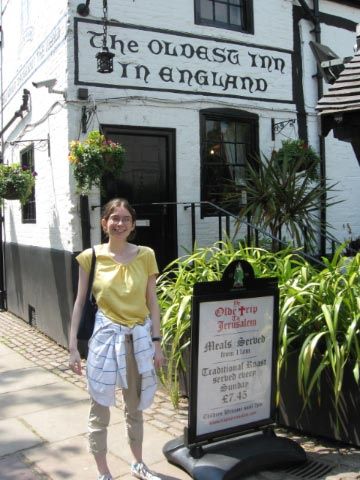
The Trip to Jerusalem Inn (or as it's now called "Ye Olde Trip to Jerusalem Inn") where Bess and her father live and work, is a real place. And if you believe the stories, it really did exist in 1193, having been built four years earlier in 1189. It gained its name because- so the story goes- Crusaders, including one Richard the Lionheart*, stopped there overnight on their way to Jerusalem. And it still stands today. Here's me standing in front of it:
And here's a side view that lets you see the whole building:
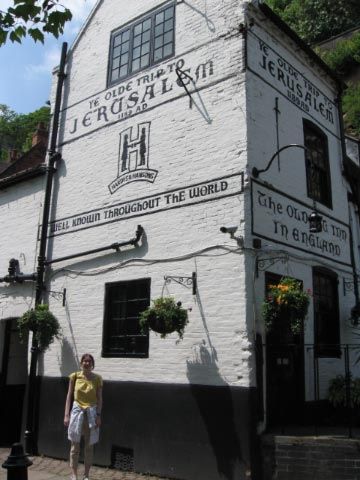
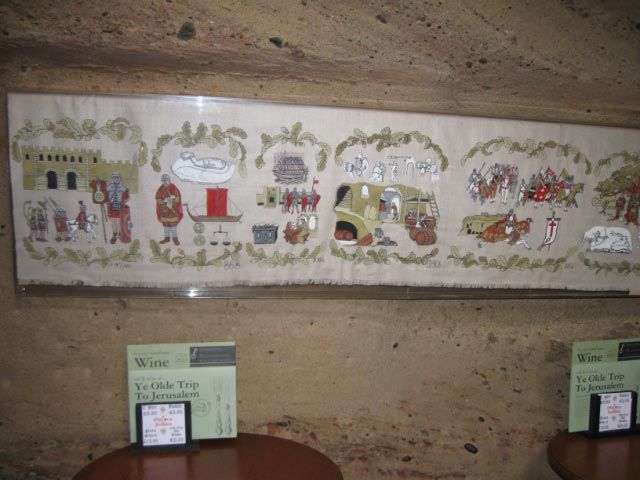
The building currently calling itself Ye Olde Trip To Jerusalem does not date from 1189, unfortunately- historians estimate that it's only about three hundred years old. But the inn is still proud of its heritage, as you can see when you go inside:
I also got to visit Nottingham Castle, where of course I took several dozen pictures:
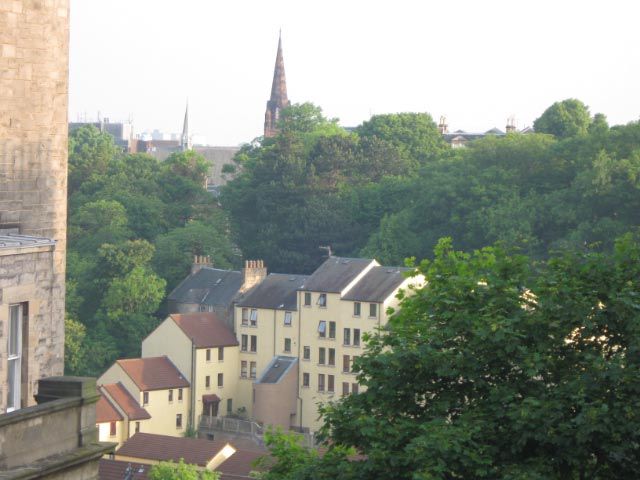
Despite what you may think, that isn't the view from the ramparts. It's from the courtyard. Nottingham Castle sits on the top of a hill, so if you assume that the castle Marian, Cecily, Guy, and the Sheriff live in is the same as the one that still stands in Nottingham today, Marian could concievably stand in the courtyard and look down at whatever was happening in town that day.
All that said- and illustrated- the Trip to Jerusalem Inn that appears in Sherwood Forest does not actually resemble the Ye Olde Trip that you see in the photos above. No, I based Bess and Thomas' Trip in a source closer to home. In the summer of 2011, I worked at Westfield Pioneer Village, which includes- among other things- the D'Aubigny Inn, built around 1820. It looks like this:

And the fictional Trip looks pretty similar. It has the same layout, too: when you come in, there's a set of stairs leading to the bedrooms and a door that leads into the main room, where you'd be served. From the main room, there's a small hallway that leads to the kitchen. That way, the main action of scenes set in the inn can take place in the main room, where the customers are, or the characters can duck back into the kitchen if they need to speak privately. Upstairs, there's one big room for guests (private rooms at inns and hotels are a relatively modern concept- back then everybody snoozed in a communal room) and two smaller ones, belonging to Bess and Thomas. Anyone feeling especially fussy about privacy- unlikely, but possible- can ask for a curtain to be drawn around their bed. And, if you're close friends with the owners (as we'll see in an upcoming installment) you might get to share their room. (If you're really, REALLY wealthy and want a more private room, I imagine you could offer Thomas a financial incentive to give up his room to you for the night. But who in Nottingham has that kind of money?)
So there you have it: a glimpse into my creative process, when it comes to historical accuracy. I've talked before about my approach to history and fiction- namely that, while it's good for authors to not propogate damaging myths about the past (COUGH COUGH PHILLIPA) I don't think slavish adherence to detail is necessary to speak greater truths about who your characters are and what they represent. As a historical fiction series, Sherwood Forest does deal with the realities of England in the twelfth century. If it didn't, there'd be no point in setting it there. But while I may stick closely to events and attitudes, I don't think a whole lot is lost by fudging the layout of the Trip to Jerusalem or muddying the chain of command as it existed in Nottingham at the time. If I didn't, there wouldn't be a story- and that would suck, wouldn't it?
(Don't answer that.)
*Unless you're Stephen Harper
*Richard the Lionheart actually sucked. Like, on a deep fundamental level as a human being, he was AWFUL. I saw a statue of him outside Westminster Abbey, and I took great pride in flipping him the bird*.
*I did the same thing to Oliver Cromwell. Britain, why do you keep building statues of these guys?

